Most of us know roughly when our period is due. Far fewer of us know why we sleep badly the same week every month, or why one Tuesday feels unstoppable and the next feels impossible. Those patterns are often there. We’ve just never been shown how to look for them.
You don’t need an app, a spreadsheet or a perfect streak. You need a few minutes, a pen, and a bit of curiosity about yourself.
First, the basics.
Day one is the first day of proper bleeding, not light spotting beforehand. Your cycle runs from day one of one period to the day before your next period starts. Count those days and you have your cycle length.
It’s normal for cycle length to vary a little from month to month. What’s useful is knowing what’s normal for you, so you notice when something changes.
What to actually write down.
Keep it to six things. A word, a tick or a number out of five is plenty.
💧Flow
None, spotting, light, medium or heavy. Note any clots or flooding too.
day 2: heavy, changed pad x6🙂Mood
One or two words. Calm, anxious, irritable, low, happy. Honest beats nice.
day 24: snappy, teary at an advert⚡Energy
A score out of five. It’s quick, and it’s the one most women find surprising over time.
day 12: 5/5, cleared my inbox🌙Sleep
Roughly how many hours, and how well. Restless? Woke at 3am?
day 26: 5 hrs, woke hot🩷Body
Cramps, headaches, bloating, tender breasts, spots, back pain. If something hurts, give it a score out of ten.
day 1: cramps 7/10, back ache🍎Food and cravings
Not what you “should” eat, just what you wanted. Cravings often tell a story.
day 25: all the toast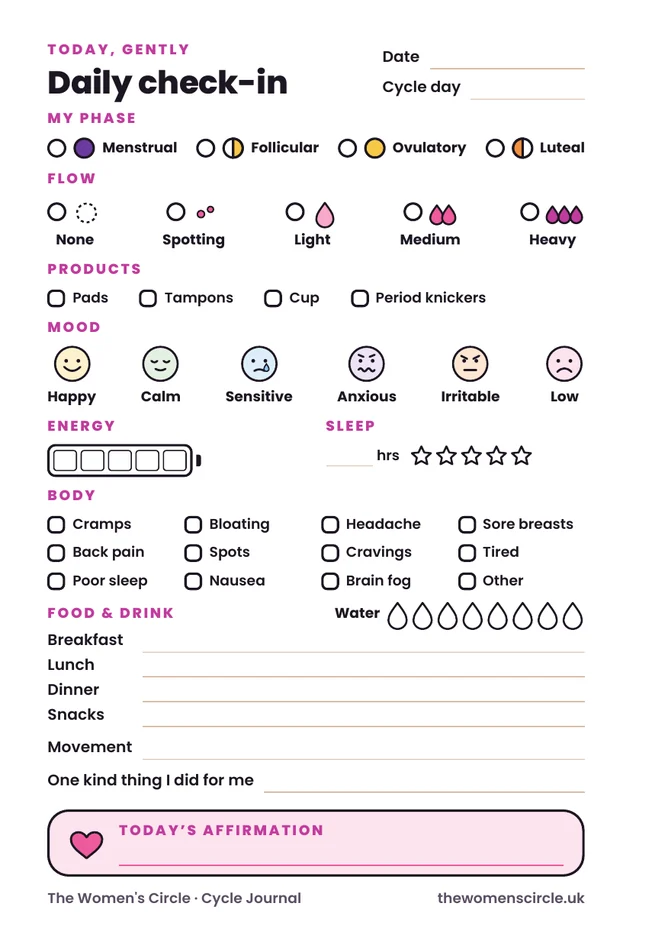
Keep it to two minutes.
- Pick a moment you already have. With your morning tea, or in bed before lights out. Same time each day makes it stick.
- Mark day one clearly. Circle it, colour it, star it. Everything else hangs off that date.
- Don’t backfill a whole week. Memory is kind but not accurate. If you miss days, just carry on. Gaps are fine.
- Don’t judge it yet. For the first month, just collect. The looking comes later.
App or paper?
Both work. The best tracker is the one you’ll actually use.
Your body keeps notes. This is how you read them.
What to look for after a few cycles.
After two or three cycles, sit down with your notes and a cup of tea. You’re looking for things that repeat:
- Your cycle length. Is it fairly steady, or does it jump around?
- The same days, the same feelings. Low mood or poor sleep that turns up in the days before your period, then lifts once it starts.
- Your good days. When your energy is highest. Some women start planning big conversations and busy weeks around these.
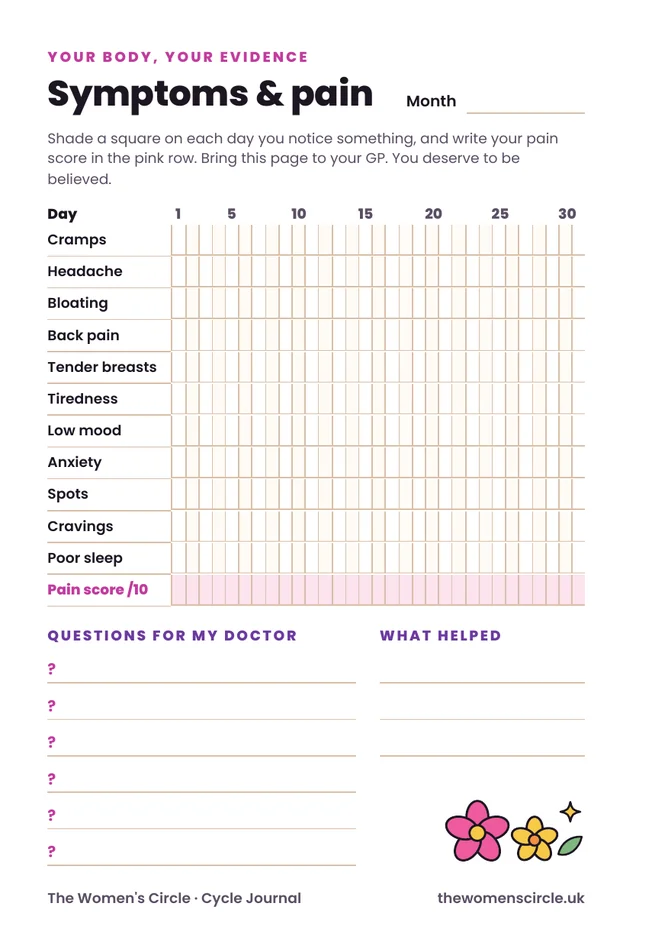
- Pain and flow. How many days hurt, how much, and whether it’s changing.
Taking your notes to your GP.
If something’s worrying you, your notes can make a short appointment far more useful. Instead of “my periods are bad”, you can say “I’ve had pain of 7 out of 10 for the first three days of each of my last three cycles”. For some conditions, such as PMDD, the mental health charity Mind says your GP may ask you to keep a detailed record of your symptoms for at least two months anyway, so you’ll already be ahead.
- periods that are very painful or very heavy
- bleeding between periods or after sex
- a cycle that suddenly changes, or periods that stop
- premenstrual changes that make everyday life hard
Good to know.
If you use hormonal contraception, are pregnant or breastfeeding, or are in perimenopause, your cycle may work quite differently. Noting your mood, sleep and body is still really worthwhile, and it can help you spot changes early.
Tracking isn’t contraception. A cycle diary or app on its own isn’t a reliable way to avoid pregnancy. If you want to talk about contraception, speak to your GP or a sexual health clinic.
Want to understand what’s happening in each part of your cycle? Read The four seasons of your cycle next.
🩷We’re a community, not a clinic. Speak to your GP or specialist.
Sources
About this read
Written by The Women’s Circle team with AI support, then checked and approved by Sophie East, Founder of The Women’s Circle. This is general information for self-reflection, not medical advice. How we write.