It’s a story many women will recognise. You finally book an appointment about your periods, wait weeks, sit down, and suddenly can’t find the words. You say “it’s probably nothing”, the ten minutes are up, and you walk out with nothing changed.
You know your body better than anyone. This guide is about walking into that room ready, so the conversation is about what’s really happening to you.
When it’s worth booking.
The NHS describes period pain as happening when your womb tightens during your period, and says it’s often normal. But sometimes there’s an underlying cause, such as endometriosis, adenomyosis, fibroids or pelvic inflammatory disease, and that’s why it’s worth getting checked when things don’t feel right.
- your periods become more painful, heavier or irregular
- period pain stops you doing your usual activities
- you have pain during sex, or when you pee or poo
- you bleed between periods
- you have a swollen tummy, lose your appetite, or lose weight without trying
Don’t wait if your pelvic or period pain is severe or worse than usual and painkillers haven’t helped. The NHS advice is to ask for an urgent GP appointment or get help from NHS 111.
Before you go: write it down.
Pain is hard to describe from memory, especially when you’re not in it. Notes from two or three cycles make a huge difference. Here’s what to capture:
- When it starts and stops. Which days of your cycle, and for how long.
- How bad it is. A score out of ten each day it hurts.
- Where it is. Low tummy, back, legs, or somewhere else.
- Your flow. How often you change your pad, tampon, cup or period pants on your heaviest days, and any clots or flooding.
- What you’ve tried. Heat, rest, over-the-counter painkillers, and whether any of it helped.
- What it stops you doing. Days off work or school, cancelled plans, nights of broken sleep.
- Anything else. Pain during sex or going to the toilet, bleeding between periods, exhaustion, low mood.
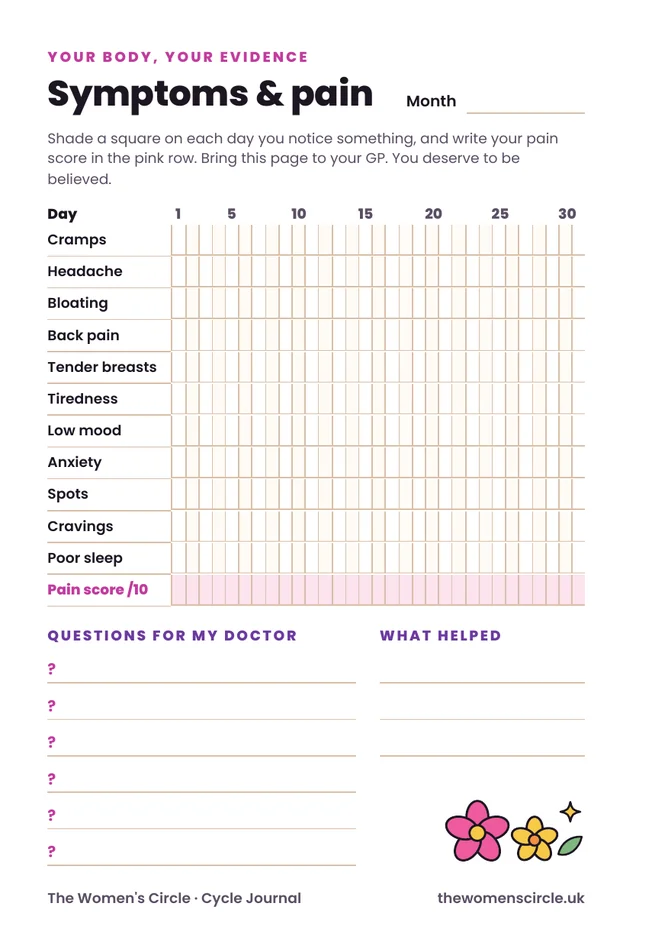
New to tracking? Our guide How to track your menstrual cycle shows you how in two minutes a day. The charity Endometriosis UK also has a free pain and symptoms diary you can use.
Say it plainly.
Many of us were raised to play pain down. In a GP appointment, that works against you. Lead with the facts and the impact.
Write your top three points on your phone or on paper, and say the most important one first. If you’re nervous, it’s fine to say so, and it’s fine to read from your notes.
Questions you can ask.
- What could be causing this? And what can we rule out?
- Are there any tests that would help? For example, the NHS mentions an ultrasound scan.
- What are my options, and what are the pros and cons of each for me?
- Could this be endometriosis or adenomyosis? If not, why not?
- What happens if this doesn’t help? When should I come back, and when would you refer me to a gynaecologist?
According to the NHS, depending on what’s going on, a GP may suggest different medicines, a TENS machine, hormonal contraception, tests such as a scan, or a referral to a gynaecologist. Ask what each one involves, so you can decide together.
Painful isn’t the same as normal.
If you don’t feel heard.
- Ask for it to be written in your notes, including what you said and what was decided.
- Ask for a longer or follow-up appointment, so the conversation isn’t squeezed.
- Take someone with you. A friend, sister or partner can help you remember and speak up.
- See a different GP. You’re allowed to ask for another opinion, including someone with an interest in women’s health.
- Keep tracking. If things don’t improve, your notes show that clearly next time.
And please don’t give up. It can take more than one appointment to feel properly listened to, and that’s not your fault.
🩷We’re a community, not a clinic. Speak to your GP or specialist.
Sources
- Period pain, NHS.
- Endometriosis, NHS.
- Endometriosis UK, including their pain and symptoms diary.
About this read
Written by The Women’s Circle team with AI support, then checked and approved by Sophie East, Founder of The Women’s Circle. This is general information, not medical advice. How we write.